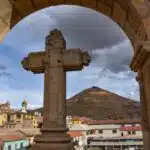
Sucre is the constitutional capital of Bolivia and the seat of its highest court. Known as the “White City”, it has whitewashed colonial buildings and red-tiled roofs. In fact, its historic centre is a UNESCO World Heritage site. Moreover, at about 2,800 metres, it has a mild climate all year.
So, this guide covers the history, top sights, markets, dinosaur tracks and practical tips.

History of Sucre
The Spanish founded the city in 1538. Later, it became a rich administrative centre thanks to the silver of nearby Potosí. Then, in 1825, Bolivia’s independence was declared here. Interestingly, the city takes its name from Antonio José de Sucre, a hero of independence.
Top Sights in Sucre
Plaza 25 de Mayo
The main square is shaded by palm trees and lined with elegant buildings. For example, the cathedral and the Casa de la Libertad stand here.
Casa de la Libertad
In this building, Bolivia’s declaration of independence was signed. Today, it is a museum about the birth of the nation.
Recoleta Viewpoint
On a hill above the centre, the Recoleta monastery offers the best view of the white city. Also, cafés under the arches are perfect at sunset.


Museum of Indigenous Art
This museum displays beautiful textiles from local communities. In addition, you can watch weavers at work.
Cal Orck’o Dinosaur Tracks
Just outside the city, a huge limestone wall holds thousands of dinosaur footprints. In fact, it is one of the largest track sites in the world. Then, visit the Parque Cretácico museum next to it.
Markets
The Central Market is perfect for fresh juices and local snacks. Moreover, on Sundays, the village of Tarabuco, about 65 km away, holds a famous market of handwoven textiles.
Best Time to Visit Sucre
The dry season, from May to October, is sunny and pleasant. However, nights can be cool. In contrast, the rainy season brings afternoon showers.
Practical Tips
- Take it easy: The altitude is lower than La Paz, but still high.
- Carry cash: Many small shops and restaurants don’t accept cards.
- Learn Spanish: The city is popular for affordable language schools.
- Walk the centre: Most sights are close together.
Getting There
Flights link the city with La Paz and Santa Cruz. Also, buses from Potosí take about three hours. For more about its heritage, see the UNESCO page for the Historic City of Sucre.
Final Thoughts on Sucre
In short, Bolivia’s white city combines colonial elegance, history and a relaxed atmosphere. Afterwards, discover the Salar de Uyuni or the ruins of Tiwanaku. Discover all our Bolivia travel guides.